
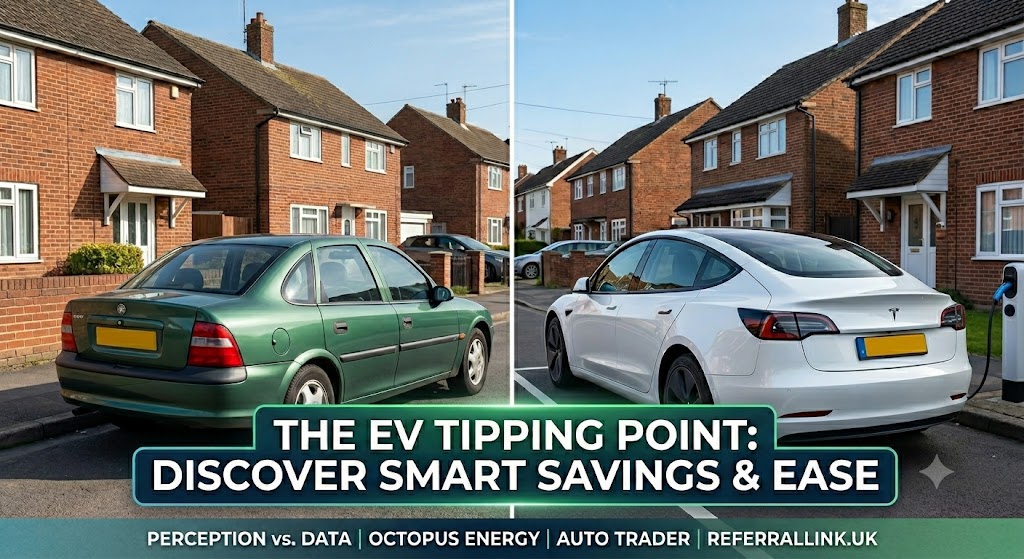
The UK automotive market has reached a monumental milestone. For years, the two biggest arguments against making the switch to an electric vehicle (EV) have been the high upfront purchase price and the anxiety surrounding charging and reliability. However, groundbreaking new data proves that these hurdles have effectively vanished.
According to the latest figures from Auto Trader, the UK’s largest automotive marketplace, new electric cars are now cheaper to buy than petrol models on average for the first time. Driven by manufacturer discounting, competitive pricing from incoming brands, and government grant support, the average transaction price for a new EV dropped to £42,620, comfortably undercutting the average petrol model price of £43,405.
With the upfront cost barrier removed, why are some drivers still hesitant?
A massive joint study—the Big Octopus Driver Survey, conducted by Octopus Electroverse and Auto Trader—surveyed over 11,500 UK motorists. The results revealed a striking “perception gap” between what petrol drivers think electric ownership is like, and the actual reality experienced by those behind the wheel.
Here is how the common myths stack up against real-world data, and how forward-thinking energy companies are helping drivers pocket massive savings.
Myth 1: “EVs are a headache to charge and maintain”
The survey highlighted a significant divide in expectations. More than half of petrol and diesel drivers stated they expected home charging to be a complicated “headache”.
In stark contrast, 87% of EV drivers who charge at home describe it as easy and convenient, frequently citing it as one of their absolute favourite aspects of ownership. Instead of detouring to a petrol station and standing in the cold, EV drivers simply plug in overnight and wake up to a “full tank” every morning.
When it comes to maintenance, fuel drivers are nine times more likely to believe that EVs cost more to keep on the road. In reality, with far fewer moving parts—no oil filters, spark plugs, or timing belts to replace—EV owners are twice as likely to rate their vehicles as more reliable than their previous petrol equivalents.
Myth 2: “Public charging is too difficult and slow”
For those worried about longer journeys, the UK’s charging infrastructure is expanding at an extraordinary pace, recently soaring past 120,000 public charge points. Two-thirds of current EV drivers report that public chargers are easy to locate and rapid to use.
Managing public charging has also become incredibly streamlined. Instead of cluttering your phone with dozens of different apps and subscriptions, drivers are using the Octopus Electroverse. It consolidates hundreds of thousands of different charging networks into one single card and app. If you want to make public charging entirely seamless, you can sign up and get started via the
Myth 3: “Running costs are higher”
The survey showed that fuel drivers are eight times more likely to assume day-to-day running costs are higher for electric vehicles. This couldn’t be further from the truth.
While petrol prices remain volatile due to global supply shocks, electric vehicle drivers are insulated from fuel-court price hikes. By pairing an EV with a specialist home energy tariff, the savings are substantial. Data from Octopus Energy reveals that drivers utilising dedicated smart tariffs—such as Octopus Go—save an average of £860 a year compared to a petrol car travelling 7,600 miles annually.
The “EV Glow” is Real
The most telling insight from the Auto Trader and Octopus report is long-term satisfaction. While the novelty of a new petrol or diesel car tends to fade over time, EV owner satisfaction remains consistently high year after year.
Overall, 85% of EV drivers say they are highly satisfied with their vehicle, using words like “convenient,” “responsive,” and “cheaper” to describe their day-to-day driving. Meanwhile, 88% of fuel drivers admit they simply need more clear information before making the switch.
With new electric cars now costing less on average than petrol equivalents, and smart energy tariffs slashing running costs to a fraction of fossil fuels, the financial case for switching has never been stronger.
If you are ready to transition your home and vehicle to cleaner, cheaper energy, you can switch your home supply over to the UK’s most awarded energy supplier using this